Leadership Burnout, Organizational Transformation and the Desire to Bring Order to Chaos
Every once in a while, you have a conversation that rearranges something in your soul.
Not because someone gives you advice.
But because they name something you’ve been circling around for years without fully seeing it.
I recently had one of those conversations about leadership, organizational transformation, and the emotional cost of navigating change inside complex systems.
I was sitting across from a woman who has spent years working inside organizational development and leadership systems. I told her I was disappointed not to receive a role I had pursued. Not because I needed the title itself, but because I wanted to understand the mismatch.
What she said didn’t land like the rejection I had steeled myself for.
It was something much more unsettling. And much more honest.
She told me she wasn’t sure my transmission gear box was flexible enough to move as slowly as large systems often require. That there was nothing inherently wrong with that, but that I would eventually need to decide whether I wanted to spend my life learning how to cultivate change slowly inside institutions…or whether I was built more to design and build outside them.
Then she gave me a metaphor that kept rolling in my brain.
She said internal organizational development work is often like tending gardens.
You till the soil.
You prepare the conditions.
You warn people what needs attention.
You nurture growth patiently over time.
And often?
You come back a year later and watch someone else harvest what you planted.
No recognition.
No ownership.
Just quiet cultivation.
Then she asked me a question that landed somewhere much deeper than career strategy.
“Do you want that?”
I paused, uncertain how to answer.
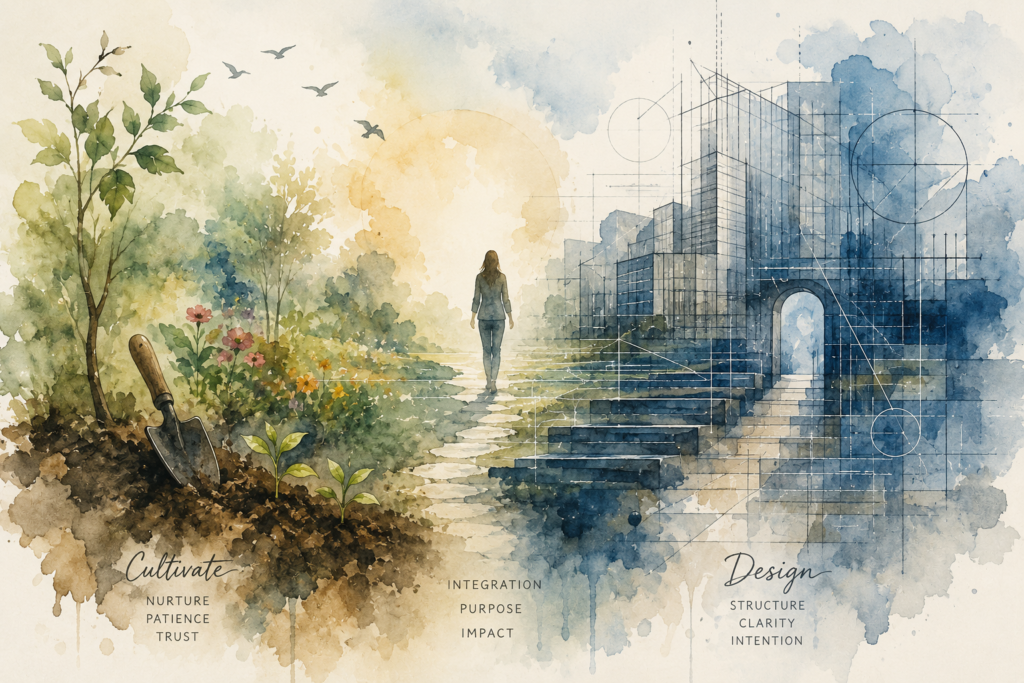
The Difference Between Cultivating Change and Designing Systems
Because the truth is, I have spent much of my life trying to bring order to chaos.
Not because I worship structure.
Because I know what it feels like to live without enough of it.
People often assume those of us who build systems, frameworks, governance models, and organizational design structures are trying to control life.
But many times we are simply trying to create enough containment for life to flourish safely.
I understand now that some of my drive toward systems thinking, clarity, architecture, and integration was adaptive.
When you grow up inside instability, you learn to scan for patterns early. You learn to anticipate breakdowns before they happen. You learn to carry invisible organizational and emotional load long before anyone formally asks you to.
You become very good at creating coherence.
And over time, that ability becomes valuable inside organizations navigating transformation, leadership strain, and operational complexity.
But it can also become exhausting.
Why High-Capacity Leaders Try to Bring Order to Chaos
Many leaders navigating organizational transformation eventually discover that change leadership is not simply about process improvement or communication plans.
It is about helping human beings move through uncertainty, identity shifts, power changes, emotional strain, and structural ambiguity while organizations continue trying to operate at full speed.
That reality changes how you see leadership.
Because transformation does not happen because of structure alone.
It happens because of relationship.
Because of trust.
Because people feel safe enough to become someone new.
Structure can support transformation.
It can protect it.
It can sustain it.
But structure itself is not the soul of transformation.
And yet…
Lack of structure can exhaust the soul.
This is the paradox I find myself living inside right now.
The Hidden Emotional Labor of Organizational Transformation
I no longer believe the answer is choosing between being a gardener or an architect.
I think the deeper question is whether we are building systems that protect life rather than suppress it.
Whether we are designing structures that allow people to grow without constantly living in survival mode.
Whether leadership is willing to create environments where both humanity and accountability can coexist.
Because behind many conversations about burnout in leadership, workforce transformation, and organizational change is a quieter reality that rarely gets discussed openly:
Some people inside systems carry enormous invisible labor.
They stablize relationships.
Translate ambiguity.
Absorb emotional strain.
Create clarity.
Anticipate breakdowns.
Hold alignment together long after formal structures stop functioning well.
Organizations often reward outcomes while overlooking the human cost required to sustain them.
Over time, that creates leadership exhaustion that no wellness initiative can fully solve.
Leadership, Burnout, and the Search for Sustainable Change
I also realize now that some people are called to cultivate slowly inside institutions.
And others are called to design new pathways entirely.
Neither is morally superior.
But they are metabolically different lives.
Some leaders are energized by long-horizon cultivation, incremental progress, and the marathon of organizational stewardship.
Others are energized by systems architecture, transformation design, and sprinting to build new models that create different possibilities.
And some of us may spend years trying to become one when we were naturally wired for the other.
At this stage in my life, I find myself less interested in proving that I can force transformation and more interest in understanding what kind of work allows me to remain whole while doing it.
Because perhaps the deeper work of leadership is not simply learning how to change systems.
Perhaps it is learning how not to lose yourself while trying to.
Learning How to Build Systems Without Losing Yourself
I still believe in transformation.
I still believe organizations can evolve.
I still believe leadership matters.
But I no longer believe sustainable change comes from forcing human being to operate indefintely inside structures that drain their humanity.
The systems we build shape the lives people are able to live inside them.
And maybe that is the real responsbility of leadership.
Not simply building faster systems.
But building environments where people can actually remain alive, honest, creative, and whole while working inside them.
If this resonates, you’re welcome to share it — or stay connected through Letters.